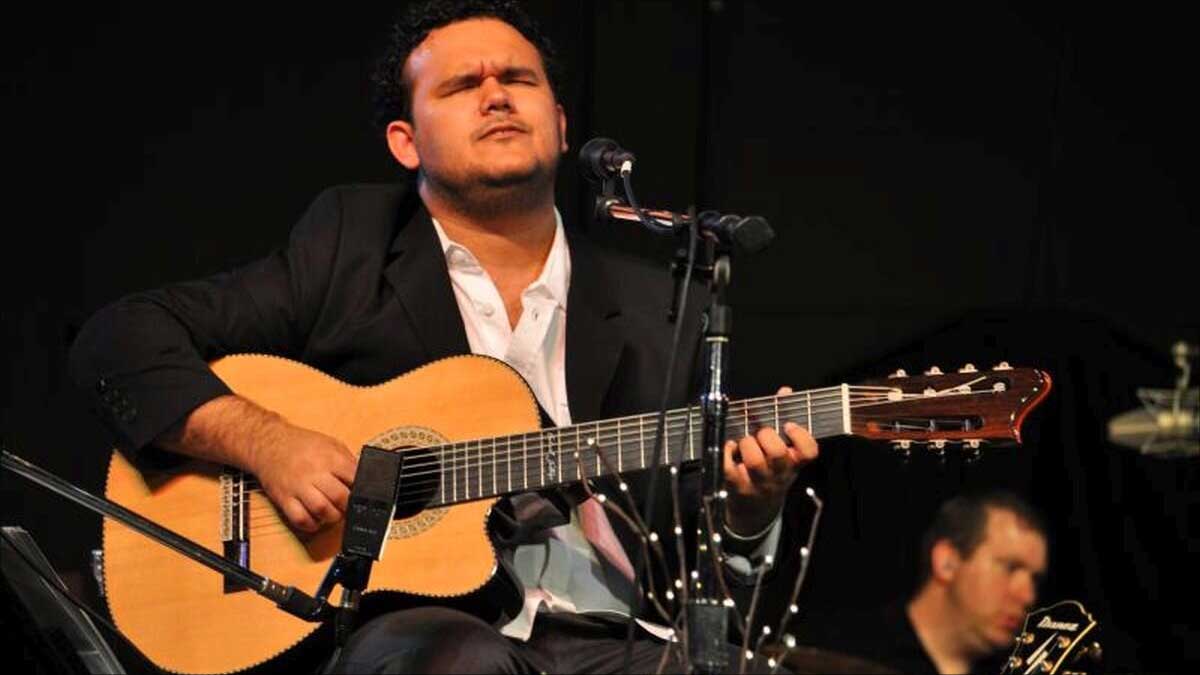
We Sit Down With One Of America’s Best-Kept Brazilian Jazz Secrets. Ready For An Introduction?
10 Questions with Gabriel Santiago reveals a musical talent deeply rooted in Bahia’s cultural traditions, and focused through the prism of Rio de Janeiro’s vibrant Jazz scene. But it took Austin Texas to bring it all together.
Trace your finger along a map of South America’s iconic hump and you’ll soon arrive in Bahia, the artistic soul of Brazil. From music to the arts, culture and cuisine, Bahia embraces the very essence of the Brazilian nation.
Continue south to discover the Bahian coastal city of Ilhéus, home to Bazil’s most beloved storyteller Jorge Amado. He is author of global bestsellers including Gabriela, Clove & Cinnamon and Dona Flor And Her Two Husbands. Amado’s novels reflect the character of the city’s people: strong, creative, and resourceful.
Ilhéus is where Brazilian jazz guitarist Gabriel Santiago was born and raised. And you are sure to hear those quartiles reflected in his music. It’s what makes Santiago’s talent all that much more impressive. You’ll hear it on his recordings, his videos, and on stage.
Recently, I invited Gabriel Santiago to share his story, and here it is. An introduction to one of America’s most talented Brazilian jazz musicians. And someone to keep an ear on.
Scott Adams, Creative Director, Connect Brazil
10 Questions with Gabriel Santiago
Table of Contents
- Front Row Center #1 – Festivals
- Coming To America
- Unpacking His Future In Texas
- Early Jazz Influences
- Front Row Center #2 – Clubs
- Teaching: Paying It Forward
- Making New Arrangements
- Front Row Center #3 – Orchestras & Big Bands
- Contact – Stay Connected
Front Row Center #1 – Festivals: The Vail Jazz Festival, July 2023
“The summer after I moved to Colorado, I had the pleasure to play at the Vail Jazz Festival with my quintet. I was able to fly in some members of my band. So, I had a nice Brazilian rhythm section, plus my friend Peter on piano and Justin Vasquez on saxophone.
That show was special because it was one of those where you feel like we got it. The energy was really special, both with the band that day and with the audience. They were really into it, and we felt it. We had presented the music the way it was desired and intended, and the audience got it. Peter and I still talk about that show.
Afterward, people in the audience came to talk to me about how they felt the music. They understood it. They told me it reminded them of concerts they saw back in the 70s and 80s, and that no one makes this music anymore, so I should keep doing it because it is special. That turns the volume up on the feeling that everybody got it, and that is what it is all about.”
Gabriel Santiago: On Growing Up In Ilhéus, Bahia
First, congratulations on how far you’ve come and all that you have accomplished. What was it like growing up in Ilhéus, Bahia as a young teen? What were your passions and interests? And what was family life like?
Yes, very much. My father, Délio Santiago, is a composer and a self-taught guitarist. Guitar was never his main job. He was a biochemist and owned an analysis lab. Music was always around the house anyway. My mother played piano when she was young and was a big music fan. So, between the two of them they collected thousands of vinyl records, so I grew up listening to music all the time. There are pictures of me as a baby crawling around guitars.
Family Ties
My mother was a journalist. She wrote a weekly column for the local newspaper, wrote poetry, and published books.
My father never pushed me to learn guitar. The guitars were right there, and he left the decision to me. One day, when I was eight, I decided I wanted to play, and that was that.
Ilhéus is a small town on the coast of northeast Brazil, and growing up there in the 80s was a wonderful experience. No internet, no computers, no cell phones. I was out all the time, barefoot in my street with my friends. We played soccer and marbles, collecting them and challenging each other. My mom usually had to phone a neighbor to find out where I was. Or the other way around, because we were always at each other’s houses. It was a very free and curious childhood. I was discovering things, learning how to make friends and how to be a friend.
It was also a beautiful place. Right in front of where I lived there is an estuary, where rivers come together. The sunsets over it are gorgeous. I fished with my father quite a bit and played a lot of dominoes. It was a really happy childhood, a very magical one, and filled with music. No surprise that I became a musician.
A Long-Held Dream: Coming To America
How did the opportunity to come to the US come about? Why Austin TX?
By then I was already set on being a professional musician. I started playing at eight, and around twelve I was playing gigs in town. A gentleman who had moved to Ilhéus from São Paulo got me interested in jazz. We had a Brazilian jazz group with a weekly gig at one restaurant, then at another. So, it started early for me. When it came time to decide what I wanted to be, in my last year of high school, I took music as my passion, my mission and my job, and I moved to Rio de Janeiro to study music at the university.
By then I was deep into jazz and Brazilian music, and I have always loved knowledge. I like to learn and to get better at something I could not do before. The music scene in the US was something that really attracted me. Plus, the chance to study more and have access to that music. Coming to the US to study was a long-term plan from the day I arrived in Rio.
Looking North To A Southern State
After I finished my master’s degree in Rio, I applied for a Fulbright grant to do doctoral studies here and I won it. The grant let me choose five institutions to apply to. UT Austin was one of them. People from my school in Rio had gone to the University of Texas to work, and I had always heard about their library on Latin American music.
I looked into their jazz department, and it seemed like a good place to be. Austin seemed like an interesting city. So, I applied to a few places, and UT accepted me first. They offered me a second scholarship on top of the one I already had. It was an easy pick. It was the right decision.
I lived in Austin for about eight years, and it is a city I really enjoy. I have many friends and fond memories there, and I go back to Texas to play every spring. This April I played a couple of shows there.
Gabriel Sanitago: Unpacking His Future In Texas
What did you bring to UT Austin as a new student and what were the growth challenges that you faced?
The first challenge was immersing myself in the American university system. Learning the routines and getting better at the language. My English was okay, but at the time I felt everybody spoke so fast. Following the classes took me a few months to catch up on. Everything was fast-paced, with 50-minute classes, homework, and I was busy all the time. It took about one semester to get the hang of it and feel acclimated.
What I brought was my Brazilian background, and not only the music. I brought my way of being. I’m an open guy, warm, and I like to talk and chat with people. And I was legitimately happy to be there. Everything was new and I was filled with passion and eager to discover things. I think I brought a bit of a happy atmosphere to the place, and people felt that.
Finding A Place In UT’s Music Space
Musically, the fit was good. I was already digesting jazz through the lens of Brazil and had come up with my own voice early. I arrived with substantial work behind me. My records, work as an arranger and composer, and projects with strings and orchestra. The albums I had produced myself, and video material from back then. I found a really open place for being myself.
The key thing was that the professors gave me free rein. I was in the UT Jazz Orchestra, the university’s main ensemble, for my whole time there as a guitarist, which helped me tremendously with reading. It was also my platform as a composer. I had to write music all the time and I used that band to do it. I also started lessons with Yevgeny Sharlat. He is a Russian classical composition professor, who importantly, expanded my horizons.
The jazz faculty encouraged me to write whatever I wanted. They did not want to put me in a box. They wanted me to develop my own box, my own way of writing for that ensemble. My compositions are not written for jazz orchestra. They are just my compositions, translated to that ensemble whenever it was available.
10 Questions with Gabriel Santiago
Influência do Jazz: An Early Introduction For Gabriel Santiago
How did you come across your interest in jazz music?
In my hometown there was a man named Edmar Tommy who had moved there from São Paulo. He was a businessman, and he loved jazz and had played it in São Paulo. My father met him, we started going to his place. Edmar saw some talent in me and took me under his wing. We started playing together, my father, Edmar and me, along with an older drummer. He is the one who introduced me to jazz. It did not come from my father.
He introduced me to all the greats. Joe Pass, Wes Montgomery and Jim Hall were the three guitarists I listened to most when I was young. For Brazilian guitarists, Hélio Delmiro and Heraldo do Monte. Among pianists, Bill Evans and Oscar Peterson, and among bass players, Ron Carter and NHØP. That set the fire in me to keep learning about this music. I was around 11 or 12 years old.
Improvising On Inspiration
Who were you listening to? Who were your early mentors and how did they inspire you?
I went through the stage every jazz student goes through, where you only listen to jazz and nothing else is as good. That is when you really get familiar with a style, when you immerse yourself in it. I listened to the greats on every instrument. A lot of Chet Baker, Sonny Rollins, Joe Henderson and John Coltrane. Around 13 or 14 I started checking out more contemporary players. That’s when I discovered Pat Metheny and Chick Corea. I was also listening to a lot of Brazilian music that came from my father, who loved it. Milton Nascimento, Djavan, Chico Buarque, João Bosco, Toninho Horta and Beto Guedes.
Edmar was my big mentor in jazz. Before him I had another mentor, Letto Nicolau, the man I learned guitar from. He was a friend of my father’s with formal training from a conservatory, and he had a little music school. My father was self-taught, so when I decided to learn guitar he did not try to teach me himself. He sent me to his friend because he wanted me to learn the proper, traditional way. I learned all of the ins and outs of the instrument, including how to read music. I credit Letto for that. He and Edmar were my early mentors.
Later, when I got to college, I had other great mentors. Antônio Guerreiro was my composition teacher in Rio, and I studied privately with him for six years. At UT, Yevgeny Sharlat, the Russian professor, was also very important to me.
10 Questions with Gabriel Santiago
Front Row Center #2 – Jazz Clubs: The Elephant Roon, Austin, Texas
The Elephant Room is a basement jazz club in Austin. It’s a bit of a dive bar that has been going for more than 30 years. At the time it was the jazz spot, and I got to play there many times. My group played Saturdays and we packed the club. There were literally lines out the door and around the block to see the band, and a lot of people came to sit in.
One night we were playing really well. I sometimes close my eyes when I play and don’t see much of what is going on in the audience. So, when I opened them and saw Eric Johnson, the legendary guitar hero, just sitting there watching the gig. It was amazing to me that a guitar hero sat down to watch me play.
My drummer, Wayne Salzmann ended up playing with Eric as well. He was the one who called Eric to come see us. We chatted afterwards, and Eric became someone I‘ve admired for a long time and then got to know a little.
I met him several times after that. I was honored that he took the time to come see me play. It was special because the club was packed, we were playing well, and a legend was watching.
Paying It Forward: Teaching Others
How did you get into teaching and what is the difference between class instruction and one on one?
I got into teaching very early, around 18, when I had just moved to Rio. It was a natural thing. I was practicing hours and hours and playing fairly well. Especially considering the level of musicians in Rio at the time. And I had spent a lot of time working on this music when I was young. People saw me play and wanted to learn what I knew, so I started giving private lessons.
I also learned early that being a full-time musician almost always means teaching, whether private lessons or at a school, because it is hard to make a living only playing gigs. I decided that if this was something I would need to do, I might as well do it well. So I got interested in teaching and in gaining the experience to be understandable and to deliver what students needed, including creating a curriculum and following the progress of students.
Gabriel Santiago And The Art Of Education
Class instruction is really different from one-on-one because your attention is divided. You have to be more general. Leave time for questions and follow an agenda. It’s a program you have to get through.
Teachers are always bounded by the student who is having the most trouble. You cannot go too fast, because the slowest student has to be at a level where everybody understands. When you are lucky enough to have a strong class, you can go beyond the main curriculum and give them more.
One-on-one is a different experience. You work with that person and address their concerns specifically. It is more interactive and in real time. You see the progress and development of that particular student, and that helps you help them as best you can.
Gabriel Santiago’s Diverse Teaching Styles
Which classes do you teach, and which classes are the most fulfilling for you?
At the University of Denver I teach composition and arranging in the jazz area. I also teach private studio composition lessons and coach a jazz combo. At Colorado State University I teach jazz guitar, I have a combo, and I also teach some jazz composition students. I also teach an online asynchronous music appreciation class at Texas Southern University in Houston. I taught in person when I lived there. Currently in person I’m at DU and CSU.
Another teaching initiative of mine is the Brazilian Guitar Institute, my online mentorship in Brazilian guitar. It is a dear project of mine. I’ve been running it for about three years, with students from all over the world.
The classes that fulfill me most are jazz composition and arranging. Well, composition in general, because I get to teach things I love and things I learned from the masters. I do not teach a conventional curriculum. I teach a lot of material you would not find in books. The advanced jazz composition and arranging class at DU is great. I teach the second part of it as well.
One of the most fulfilling parts of teaching are the one-on-one composition lessons. I can dig deep into what the student is doing. I can offer direction and options, follow their process and share a little of mine.
Gabriel Santiago: Making New Arrangements
Arranging is part of the creative arch. It begins with an initial melodic thought and completes itself when performed and shared with an audience. What are your thoughts?
I do like to arrange, and I would answer both parts together. For me, composition and arranging are the same thing. I do not see them as different. It is the same process and the same approach. The only difference is that in arranging I am working with material I did not compose.
I treat an arrangement as a composition. So, I find my own materials. I add things, and I aim to bring some personality to the arrangement of a tune. The same personality I bring to composing one. So yes, I would define composition by that same arc. From the first melodic thought to the performance shared with an audience.
One piece of material is mine from the start, and the other did not come from me initially. The approach, with the personal touch, is the same.
10 Questions with Gabriel Santiago
Front Row Center #3 – Big Band & Orchestral
I had several great moments with the big band. I’ll pick the performance at the Austin Jazz Festival in 2011. It’s on the Alive DVD. Zilker Park in Austin has an amphitheater, the Zilker Hillside Theater. People sit on a grassy slope. The festival was hosted there and we played with the big band. There were a lot of people, and children were dancing in front of us. It was a really special concert, and we filmed and recorded it.
The other one is the premiere of River of Memory at my doctoral recital in October 2012. It is a symphonic piece of more than 20 minutes, and there is no guitar in it. I do not play on it. It was the final project I did for my doctoral studies and the largest recital the university had ever hosted.
This is the most ambitious work I have composed. The piece is inspired by the rivers I watched growing up in Ilhéus. It was special for the music, for finishing my studies, and for producing and managing a concert with more than 70 players. The logistics of rehearsals were a nightmare in a way, on top of finishing the music and rehearsing.
My family came to watch. My father came, my mother came from my hometown, and my sister came. The piece is dedicated to my mother.
Since I do not play in it, I got to go down into the audience and sit next to them. That was a special moment for me. It was filmed, recorded and released as the album Symphonic. So I can relive that moment whenever I listen to it. I have a great memory of that time, and it was also a really special one.
10 Questions with Gabriel Santiago
Stay Connected
Stay Connected With Gabriel Santiago
Buy here: Amazon Music | Apple Music | Spotify | Bandcamp
Livestreams: Listen free on: Bossa Nova Love Affair | Brazilian Jazz | New Music: Brazil | Brazilian Jazz Instrumentals | Our Streaming Station
Music, Travel, Friends, And Fun!
10 Questions with Gabriel Santiago
Stories like ’10 Questions with Gabriel Santiago’ are what we do. Why don’t you join us?
Sign up for our e-letter. Listen to Brazil Back2Back on demand and our live streaming station. Explore our top stories, our Music Charts, and streaming channels, always free. Like our Facebook page and follow us on X (Twitter) and Instagram.